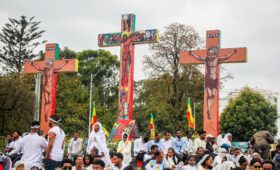

Meskel falls on Sunday 27 September 2026. The Demera — the towering bonfire that gives the festival its shape — is built and lit on the eve, Saturday 26 September. If you are travelling to see it, the 26th is the date that matters.
Meskel is not a parade laid on for visitors. It is a religious observance that Ethiopians have kept for centuries, and it happens whether anyone is watching or not. That is precisely what makes it worth seeing. In 2013 UNESCO inscribed it on the Representative List of the Intangible Cultural Heritage of Humanity under its formal name, the Commemoration feast of the finding of the True Holy Cross of Christ.
When is Meskel 2026?
Meskel is Meskerem 17 in the Ethiopian calendar. In 2026 that is Sunday 27 September, and it is a national public holiday in Ethiopia. The Demera ceremony is held on the eve, Saturday 26 September.
You will see both dates quoted, and it is worth understanding why. UNESCO’s own description of the element gives the date as 26 September, because the bonfire — the part almost everyone travels for — belongs to the eve. The feast day itself is the 27th. Neither source is wrong. They are describing two halves of the same festival.
The Gregorian date can also shift by a day in the year before an Ethiopian leap year, so a date you read for a different year will not always transfer. For 2026, it is the 26th and the 27th.
What Meskel commemorates
Meskel means cross in Ge’ez. The festival marks the tradition that Empress Helena, mother of Constantine the Great, located the cross on which Christ was crucified in the fourth century. In the Ethiopian telling, she lit a bonfire and followed the direction of its smoke to the place where the cross lay buried.
That is the thread running from the story to the practice: every Demera lit across the country is a re-enactment of that first fire. It is why the bonfire is not decoration but the centre of the whole event.
What actually happens at the Demera
The Demera is a conical pyre — long poles bound upright, packed around with bundles of branches and torches, and dressed with green grass and the golden Adey Abeba daisies that have been in bloom since the Ethiopian new year two weeks earlier. Building it is a public act in itself, and in Addis Ababa the structure goes up in the square that is named after the festival.
By the time it is lit, the square is full. UNESCO records hundreds of thousands of people gathering. Priests of the Ethiopian Orthodox Tewahedo Church, in embroidered velvet robes and carrying ceremonial umbrellas, chant and perform a slow rhythmic dance in front of the pyre, accompanied by drums and sistra. At the climax the Patriarch lights the fire.
What follows is the part people remember. The crowd watches which way the pyre falls as it burns down, and reads meaning into it. People mark their foreheads with ash from the embers. Then it becomes a street party.
Where to watch it
Addis Ababa — Meskel Square
The largest single gathering, the Patriarch, the full liturgical procession, and by far the easiest to reach. It is also the most crowded and the most managed. If you have one evening and you are already in the capital, this is the one. An Addis Ababa city tour the same day gives you the churches and the museums before the square fills up.
Gondar and the northern towns
Smaller Demeras, far less managed, and much closer to the people lighting them. In the historic north the ceremony sits against seventeenth-century castle walls and church compounds rather than a modern square. If you want photographs that do not look like everyone else’s, go north. Our Lalibela and Gondar heritage tour covers this route.
Everywhere else
Meskel is observed nationwide, across ethnic and linguistic lines, and neighbourhood Demeras are lit in ordinary streets and church yards. Some of the best evenings are the ones nobody organised. If you are staying with a family or in a small town, you do not need to travel to find one.
Practical advice for visitors
- Arrive early. The ceremony builds over the late afternoon and the lighting comes at the end of it. Timings are not published far ahead and can move — confirm locally on the day rather than relying on anything written weeks in advance.
- Dress for a church occasion. Shoulders and knees covered. Many Ethiopians wear white. A white scarf is the single easiest thing you can do to look like you understood the room.
- Dress for cold, too. Addis sits high and the temperature drops hard once the sun goes. See our Ethiopia packing list.
- Ask before photographing people. Priests and worshippers are not exhibits. Almost everyone says yes if you ask.
- Expect crowds and plan how you leave. Traffic around the square after the fire is heavy. Agree a meeting point.
- Book accommodation early. Meskel is a domestic travel weekend as well as an international one.
Meskel in the wider September season
September is the turn of the Ethiopian year. The long rains end, the highlands go green and then gold, and three things happen in quick succession: Enkutatash on 11 September, Meskel on the 26th and 27th, and the start of the dry travel season that runs through to spring.
That makes late September an unusually good time to arrive. The landscape is at its best, the roads have dried out, and the country is already in a festival mood. For the full picture across the year, see our month-by-month guide to the best time to visit Ethiopia, and our overview of Ethiopian festivals for what comes next.
Can you still plan a trip for Meskel 2026?
If you are reading this in the days before the festival, the honest answer depends on your visa. Ethiopia issues an eVisa online and processing is usually quick, but it is not instant — check the requirements and current fees in our Ethiopia visa guide before you book flights.
If 2026 is too tight, plan for 2027. Meskel is fixed to Meskerem 17 every year, so it is one of the easiest Ethiopian festivals to build a trip around, and pairing it with the northern historic route makes a strong ten days. Talk to us and we will put an itinerary together.
Frequently asked questions
When is Meskel 2026?
Meskel 2026 is Sunday 27 September, which is Meskerem 17 in the Ethiopian calendar. The Demera bonfire ceremony is held on the eve, Saturday 26 September. Both are within the Meskel public holiday period in Ethiopia.
What is the Demera?
The Demera is the bonfire at the heart of Meskel: a conical pyre of poles and bundled branches, decorated with green grass and yellow Adey Abeba daisies. It re-enacts the fire that Empress Helena is said to have lit when searching for the True Cross. In Addis Ababa it is lit by the Patriarch of the Ethiopian Orthodox Tewahedo Church.
Is Meskel a UNESCO heritage festival?
Yes. Meskel was inscribed on UNESCO’s Representative List of the Intangible Cultural Heritage of Humanity in 2013, listed formally as the Commemoration feast of the finding of the True Holy Cross of Christ.
Where is the best place to see Meskel in Ethiopia?
Meskel Square in Addis Ababa hosts the largest ceremony, with the Patriarch and hundreds of thousands of people. Gondar and the northern historic towns offer smaller, less managed Demeras against castle and church architecture, which many photographers prefer. Neighbourhood bonfires are lit across the whole country.
What should I wear to Meskel?
Dress as you would for a church service: shoulders and knees covered. Many Ethiopians wear white, and a white shawl or scarf is a simple, respectful choice. Bring a warm layer as well, because Addis Ababa is at high altitude and the temperature drops sharply after sunset.
Is Meskel the same as Timket?
No. Meskel, in late September, commemorates the finding of the True Cross and centres on the Demera bonfire. Timket, on 19 January, celebrates the baptism of Christ and centres on water, with processions and a mass renewal of baptismal vows. Both are Ethiopian Orthodox festivals inscribed by UNESCO, but they are separate events six months apart.