Ethiopian New Year — Enkutatash — falls on Friday 11 September 2026, and it opens the Ethiopian year 2019. It is the first day of Meskerem, the month that arrives as the long rains stop, and it is announced across the highlands by a small yellow daisy called the Adey Abeba.
If you have never spent a September in Ethiopia, this is the one to understand. The country does not slide into its new year in the dark of winter. It arrives at the exact moment the rain stops, the cloud lifts off the escarpments, and every roadside, field and churchyard turns yellow at once. Ethiopians do not need a calendar to know the year has turned. They look out of the window.
When is Ethiopian New Year 2026?
Friday 11 September 2026. Enkutatash falls on 11 September in most years, and on 12 September in the year preceding an Ethiopian leap year. It is Meskerem 1 — the first day of the first month — and it begins the Ethiopian year 2019.
It is a national public holiday. Government offices, banks and most businesses close. Expect quieter roads in Addis Ababa on the day itself, and very full ones the evening before, as families travel to be together.
Why is the Ethiopian calendar seven to eight years behind?
Because two monks did the same sum and got different answers.
The Gregorian calendar follows the calculation of Dionysius Exiguus, a sixth-century monk, for the date of the Annunciation. The Ethiopian Orthodox Tewahedo Church follows Annianus of Alexandria, a fifth-century monk, who placed the same event exactly eight years later. Neither tradition revised to match the other, so the two calendars have run eight years apart ever since — seven, for the part of the Gregorian year that falls before 11 September.
The Ethiopian year is also built differently: thirteen months, twelve of thirty days each, plus a short thirteenth month called Pagumé of five days, or six in a leap year. That thirteenth month is where Ethiopia’s tourism slogan — thirteen months of sunshine — comes from.
What does “Enkutatash” mean?
“Gift of jewels.”
Ethiopian tradition holds that the Queen of Sheba — Makeda — returned home from her visit to King Solomon in Jerusalem, and that her chiefs welcomed her back by replenishing her treasury with jewels. The name of the festival has carried that welcome ever since. It is a story about coming home at the turn of the year, which is exactly what Ethiopian families still do.
The Adey Abeba: the flower that announces the year
The Adey Abeba is a small golden-yellow daisy, Bidens macroptera, native to the Ethiopian highlands. It flowers densely and almost all at once in September, as the kiremt rains withdraw — which is why yellow is the colour of the Ethiopian new year, on greeting cards, on clothing, and on the hills themselves.
It is not a decoration chosen for the occasion. It is a wild plant that happens to bloom the same week the year turns, every year, without being asked. That coincidence has carried the meaning of Enkutatash for centuries.
Why children carry it door to door
On the morning of Enkutatash, children — traditionally girls, in new clothes — gather bunches of Adey Abeba, walk to the houses of neighbours and relatives, and sing new-year songs at the door. The song is called Abebayehosh. In return they are given a small gift: a coin, a piece of bread, sometimes a few birr.
Boys, by tradition, paint pictures and bring those instead. In cities the custom has partly shifted to printed new-year cards among adults, but walk through any residential neighbourhood of Addis Ababa on 11 September and you will still hear the singing.
How Enkutatash is celebrated
It starts in church, before dawn. Orthodox families attend an all-night or early-morning service. The largest gathering in the country is at Raguel Church on Mount Entoto, on the ridge above Addis Ababa — thousands of people in white shawls climbing the hill in the dark.
Then it moves to the house. The meal is doro wat — chicken slow-cooked in berbere and onion, with hard-boiled egg — served on injera, the sourdough flatbread that doubles as plate and cutlery. In many households a sheep is slaughtered for the day. A coffee ceremony follows: green beans roasted in front of you, ground by hand, and brewed three times. You are expected to stay for all three rounds. Refusing the third is a small rudeness.
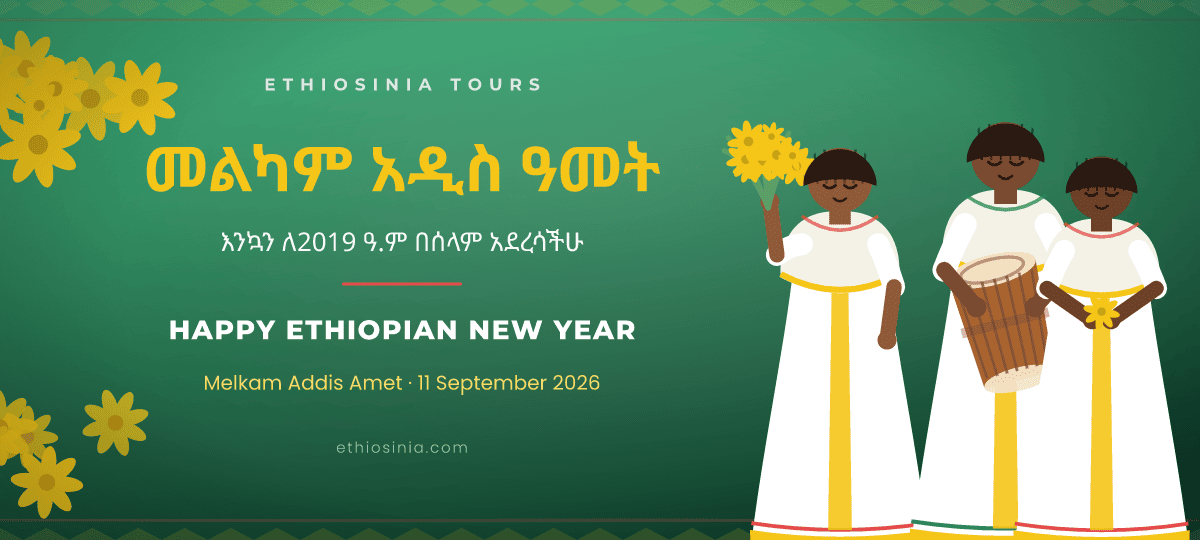
The greeting you will hear everywhere is Melkam Addis Amet — happy new year.
September’s second festival: Meskel, 27 September
Sixteen days after the new year comes Meskel, on Sunday 27 September 2026 — and for many visitors it is the more spectacular of the two.
Meskel commemorates the finding of the True Cross by Empress Helena in the fourth century. In 2013 it became Ethiopia’s first tradition inscribed on the UNESCO list of Intangible Cultural Heritage of Humanity.
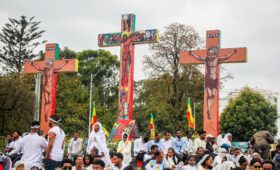
The centrepiece is the Demera: a tall conical pyre of poles bound with branches and torches, dressed with green grass and — here is the thread that ties the whole month together — Adey Abeba daisies. It is raised in Addis Ababa’s Meskel Square, and in Gondar, Axum and towns across the highlands. On the eve of the feast, 26 September, priests process around it in embroidered velvet and gold, the crowd sings, and the Demera is lit after dark. Which way the burning cross falls is read as an omen for the year ahead.
If you can only be in Ethiopia for one September date, make it this one.
What September actually looks like for a traveller
Honestly? September is a transition month, and the first half is not the same country as the second.
The kiremt rains taper through the first ten days or so, and roads in the far south and the lowlands can still be difficult. But from around Enkutatash onwards the highlands are at their best of the entire year: the escarpments are green rather than dust-brown, the air is washed clean, visibility is enormous, and the wildflowers — the Adey Abeba among them — are out everywhere. Photographers who know Ethiopia deliberately come now rather than in January.
The trade-off is that late September opens Ethiopia’s main season, and Meskel week fills hotels in Addis Ababa and Gondar. If you are reading this in early September hoping to travel this month, focus on Addis Ababa and the Oromia day-trip circuit — both are straightforward at short notice. Our Addis Ababa full-day city tour includes Entoto Hill, which is where the city goes for both Enkutatash and the Meskel processions, and the Menagesha Suba Forest Park day trip is the easiest place near the capital to see the highland wildflowers properly.
If you are planning further ahead — and most people reading this in September are planning for December or January — the northern historic route is the classic choice, and Gondar is one of the great Meskel cities. Our Lalibela and Gondar heritage tour covers that circuit, and our month-by-month guide to the best time to visit Ethiopia sets out what each part of the country is doing in each season.
Melkam Addis Amet from all of us at Ethiosinia Tours. If you want to build a trip around Meskel, Timket or the green season, tell us your dates and we will tell you honestly what is and is not realistic.
Frequently Asked Questions
When is Ethiopian New Year 2026?
Ethiopian New Year, Enkutatash, is on Friday 11 September 2026. It is Meskerem 1 in the Ethiopian calendar and begins the Ethiopian year 2019. It is a national public holiday in Ethiopia.
What is the Adey Abeba flower?
The Adey Abeba is a golden-yellow daisy native to the Ethiopian highlands, botanically Bidens macroptera. It blooms densely in September as the rainy season ends, which is why it has become the symbol of the Ethiopian new year. Children traditionally gather bunches of it and take them to neighbours while singing new-year songs.
Why is the Ethiopian calendar different from the Gregorian one?
The Ethiopian Orthodox Church follows the fifth-century calculation of Annianus of Alexandria for the date of the Annunciation, while the Gregorian calendar follows the sixth-century calculation of Dionysius Exiguus. The two are exactly eight years apart. The Ethiopian year also has thirteen months: twelve of thirty days plus a five- or six-day month called Pagume.
When is Meskel 2026?
Meskel falls on Sunday 27 September 2026. The Demera bonfire is raised and lit on the eve, 26 September, in Meskel Square in Addis Ababa and in cities including Gondar and Axum. Meskel was inscribed on the UNESCO list of Intangible Cultural Heritage of Humanity in 2013.
Is September a good time to visit Ethiopia?
The second half of September is excellent for the highlands: the rains have ended, the landscape is green, visibility is at its best and the wildflowers are out. The first ten days can still be wet, and some lowland and southern roads remain difficult. Late September also marks the start of Ethiopia’s main tourist season, so accommodation around Meskel books up early.
How do you say happy new year in Amharic?
Melkam Addis Amet — happy new year. You will hear it everywhere in the days around 11 September.