The Simien Mountains are what the edge of a continent looks like. More than 30 million years of erosion have sculpted the Ethiopian plateau into a dramatic amphitheatre of basalt cliffs, deep gorges, and flat-topped peaks that drop away for hundreds of metres. On a Simien Mountains trek, you walk the rim of one of Africa’s most spectacular escarpments, through landscapes shared with some of the world’s rarest wildlife.
The Simien Mountains National Park
Simien Mountains National Park covers approximately 412 km² in the Gondar Zone of Amhara Region, at elevations ranging from 1,900m to 4,550m. Ras Dashen — Ethiopia’s highest peak and the fourth-highest in Africa — sits within the park boundary. The park has held UNESCO World Heritage status since 1978, with its extraordinary escarpment geology and endemic wildlife as the dual basis for inscription.
A 5-day Simien Mountains trek follows the established camp routes along the northern escarpment, typically beginning at Sankaber and moving through Geech and Chennek camps. The scenery changes meaningfully each day: from broad Afroalpine meadows to sheer cliffs dropping 1,500m to the distant lowlands, with Gelada baboon troops almost guaranteed from day one.
Wildlife: what you’ll see
Three large mammals found nowhere else on Earth live in Simien:
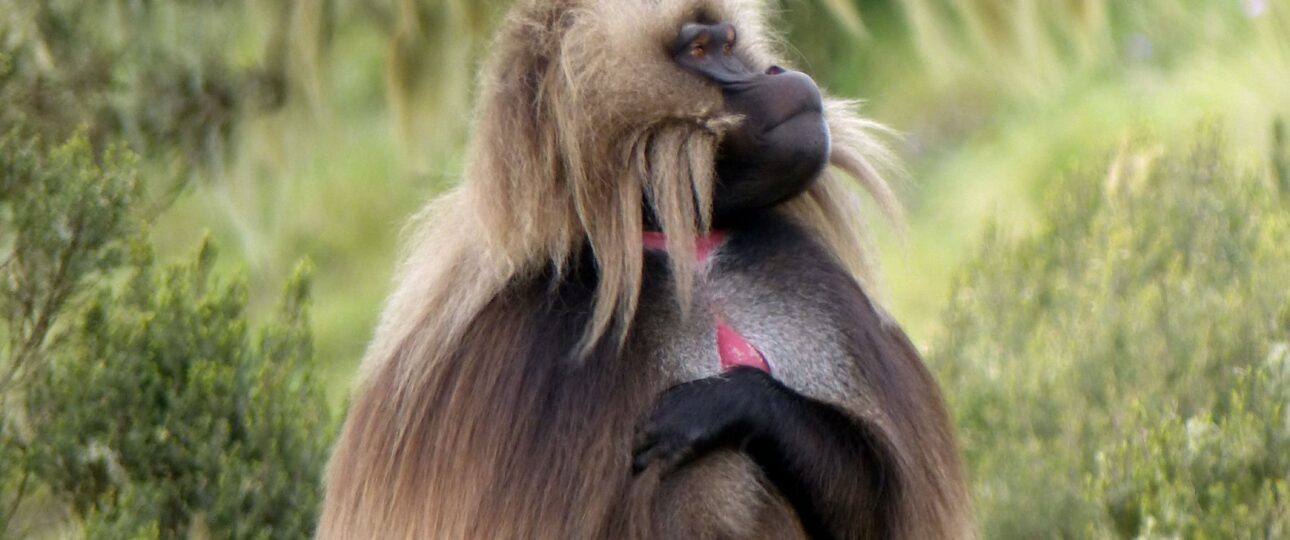
Gelada baboon (Theropithecus gelada): The Simien’s most visible animal, and one of its most remarkable. Geladas are the last surviving species of a once-widespread grass-grazing primate. Large troops of several hundred animals graze the cliff-edge meadows, their distinctive red hourglass chest patch catching the light. Their complex social structure — harems, all-male groups, large herds — makes for compelling watching. Geladas will feed within a few metres of passing trekkers.
Ethiopian wolf (Canis simensis): The world’s rarest canid, with fewer than 500 individuals remaining. Found on the high moorland above 3,500m, most reliably at dawn. The extended Ras Dashen route increases the chance of a sighting; the standard 5-day route passes through lower elevations where wolves are less frequent. For the highest chance of wolf sightings, the Bale Mountains (home to the largest population) is the more reliable destination.
Walia ibex (Capra walie): A wild mountain goat endemic to the Simien, with curved horns and sure footing on sheer rock. Most commonly seen near Chennek camp, where the cliffs provide their preferred habitat. The Walia ibex population has recovered significantly since hunting was banned.
Bird life is exceptional throughout: lammergeier (bearded vulture) with wingspans over 2.5m soar the escarpment thermals, the thick-billed raven is a constant camp companion, and the endemic Wattled Ibis and Blue-winged Goose appear on the high moorland.
Day-by-day route overview
Day 1 — Gondar to Sankaber (3,250m): Drive 90 minutes from Gondar to the park entrance at Buyit Ras, then hike approximately 12 km along the escarpment edge to Sankaber camp. First sightings of the escarpment across the Keber River gorge. Gelada troops frequent this stretch.
Day 2 — Sankaber to Geech (3,600m): A classic Simien day: the trail skirts the cliff edge almost continuously. The view across the gorge system remains constant, changing light and angle with every hour. Approximately 14 km. High probability of Gelada encounters.
Day 3 — Geech to Chennek (3,620m): The route passes through Imet Gogo (3,926m), the park’s finest viewpoint — a promontory jutting out over a sheer 1,500m drop to the lowlands. On clear days, visibility extends 100 km north. Walia ibex are frequently spotted on the slopes near Chennek camp. Approximately 12 km.
Day 4 — Chennek area exploration: A rest and exploration day: shorter walks around the Chennek escarpment, or for those on the extended Ras Dashen route, a long approach day toward the high camp at 4,200m.
Day 5 — Return to Gondar: Return from Chennek by vehicle to Gondar, with time to visit the Fasil Ghebbi royal enclosure (a separate UNESCO World Heritage site) if not already explored.
Fitness level and altitude
The 5-day route covers 40–55 km of mountain trail across four walking days, averaging 10–15 km per day with moderate elevation change. The altitude is the primary challenge: Sankaber camp sits at 3,250m and Chennek at 3,620m — high enough to cause mild altitude symptoms (headache, disrupted sleep, reduced appetite) in unacclimatised trekkers.
Spending one night in Gondar (2,133m) before starting the trek provides useful acclimatisation. No technical climbing is involved on the standard 5-day route. Anyone who walks regularly and is comfortable on uneven terrain at a moderate pace will manage it comfortably. The Ras Dashen summit add-on is longer and significantly more demanding.
Experience the Simien on our 5-day Simien Mountains Trekking Adventure — local guides, park permits, armed scout, camping equipment, and cook crew all included.
Frequently Asked Questions
What is the best time to trek the Simien Mountains?
October through March is the optimal trekking season: skies are clear, visibility across the escarpment is at its best, and trails are dry. April and May see the short rains but remain largely manageable. June to September is the main rainy season — trails become muddy, the escarpment is frequently in cloud, and the trekking experience is significantly diminished. January and February offer the clearest conditions of the year.
Do I need permits to trek in the Simien Mountains?
Yes. An entry permit and a compulsory armed scout (ranger) are required for all trekkers and are arranged by your tour operator. Nightly camping fees also apply. These costs are included in Ethiosinia’s tour pricing — there are no hidden fees on arrival.
Can I see Ethiopian wolves on the 5-day Simien trek?
Ethiopian wolves are present in Simien but are not guaranteed on the standard 5-day route, which does not consistently reach the high moorland above 3,800m where they concentrate. Guests on the extended Ras Dashen route have a better chance. For the most reliable Ethiopian wolf sightings, the Bale Mountains National Park — home to the world’s largest remaining wolf population — is the better choice. Ethiosinia offers dedicated Bale Mountains tours.
How do I get to the Simien Mountains from Addis Ababa?
Gondar (the base for Simien treks) is served by daily Ethiopian Airlines flights from Addis Ababa, approximately 1 hour 20 minutes. The park entrance is 90 minutes’ drive from Gondar. Ethiosinia’s Simien trek package includes airport transfers and all ground transport.