In the 12th century, King Lalibela of the Zagwe dynasty set out to build a New Jerusalem in the Ethiopian highlands. The result — eleven churches hewn directly from living volcanic rock — remains one of the world’s most extraordinary architectural achievements and Ethiopia’s most visited pilgrimage site. A Lalibela rock churches tour is as much a living cultural experience as an archaeological one.
What makes Lalibela extraordinary
Unlike any built structure, Lalibela’s churches were carved downward into volcanic rock: roofs first, then walls, then interiors, until each church stood in its own open-cut trench or cave, connected to others by tunnels and narrow passageways. The precision of the cutting — some walls measured to within millimetres, columns perfectly aligned — was achieved without power tools, by craftsmen working under royal commission over an estimated 24 years.
The churches remain fully active Orthodox Christian sites. Pilgrims visit year-round, and on major feast days — particularly Genna (Ethiopian Christmas, 7 January) and Timket (Epiphany, 19 January) — tens of thousands of white-robed worshippers converge on the site. Walking through Lalibela is walking through a working religious complex, not a museum.
The Northern Group
The northern cluster of churches is the largest and most visited. Bete Medhane Alem (House of the Saviour of the World) is the largest monolithic church in the world — a single block of rock carved free on all sides, measuring approximately 33 by 23 metres. It is supported by 36 exterior and 36 interior columns, and the interior feels, unmistakably, like a cathedral.
Adjacent Bete Maryam (House of Mary) is among the oldest churches in the complex and contains the most elaborate interior carvings: geometric patterns, crosses, and a face of the Madonna and Child on one interior pillar. Natural light enters at different angles throughout the day, dramatically changing how the space reads.
Bete Golgotha-Mikael is significant as the burial place of King Lalibela himself, with the nearby Tomb of Adam among Ethiopia’s holiest sites. Photography is restricted in several northern group churches — always check with your guide before raising a camera.
The Eastern Group
The eastern complex is connected to the northern group by a 35-metre tunnel cut through solid rock. Bete Amanuel is perhaps the finest example of the Lalibela style: precisely cut exterior false windows and doors, symmetrical and formal in a way that suggests a fully developed architectural vocabulary. Many architectural historians consider it the most technically accomplished of all eleven churches.
Bete Mercurios and Bete Abba Libanos are semi-monolithic — carved into a cliff face rather than fully free-standing — and the surrounding cave walls preserve remarkable frescoes. The pilgrimage route through the eastern complex passes through narrow rock-cut passages that open unexpectedly onto views of the Lasta valley below.
Bete Giyorgis: the iconic church
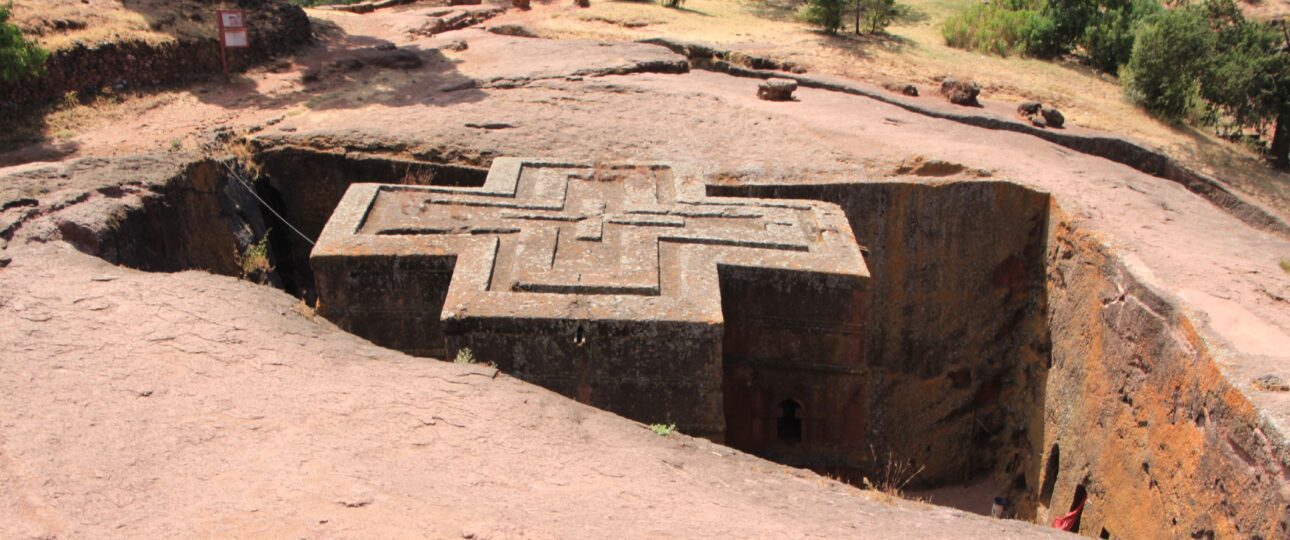
Set apart from the main clusters, Bete Giyorgis (House of St George) is Lalibela’s most photographed monument. A perfect cube carved into a pit, its roof is incised with three nested crosses — one inside the other, each diminishing in size. It is dedicated to St George, the patron saint of Ethiopia.
The approach is through a narrow trench cut into the hillside, which opens suddenly onto the pit. The effect is theatrical: the church appears below you, the cross pattern on its roof at eye level, the geometry startlingly precise. Arrive at early morning for the best light.
Lalibela during festivals
Visiting Lalibela during a major Orthodox festival transforms the experience entirely. Genna (Ethiopian Christmas, 7 January) and Timket (Epiphany, 19 January) are the two largest. During Timket, the Tabot — a replica of the Ark of the Covenant — is carried from each church in a torchlit procession the evening before, with drumming and chanting throughout the night. The following morning, blessing of the water and re-enactment of the Baptism of Christ draws huge crowds.
Festival accommodation books many months in advance. If you’re planning a festival visit, contact your operator early. Tourist access to some areas is restricted during active services, but the overall atmosphere is extraordinary and worth planning around.
When to visit Lalibela
Lalibela sits at 2,630m, so temperatures are mild year-round. The dry season (October to May) offers the clearest skies for photography. The long rains (June to September) bring mist and green hills, with fewer tourists but occasionally muddy access roads. January is peak festival season — spectacular, but crowded.
Explore Lalibela as part of our 7-day Lalibela and Gondar Heritage Tour — combining both UNESCO World Heritage sites with expert local guides and domestic flights included.
Frequently Asked Questions
How many days do you need in Lalibela?
Two full days is the minimum to visit all eleven churches without rushing. Three days allows time to explore the surrounding countryside, visit the nearby monastery of Yimrehane Krestos (older than Lalibela’s churches and set in a remarkable cave), and attend morning mass — a genuinely moving experience. Ethiosinia’s 7-day tour includes two full days in Lalibela.
Do you need a guide to visit Lalibela’s churches?
While it’s technically possible to walk between the churches without a guide, a licensed guide transforms the experience. The history, iconography, and hidden details — carved faces barely visible in shadow, tunnels not shown on tourist maps, the specific saints depicted in each church — only become apparent with expert narration. Ethiosinia assigns local Lalibela guides who have grown up with these sites.
How do I get to Lalibela?
Ethiopian Airlines operates direct flights from Addis Ababa to Lalibela Airport (LLI), typically under an hour. Overland routes from Woldia exist but involve a half-day journey on rough mountain roads from the main highway. All Ethiosinia Lalibela tours include domestic flights in the package price.
Is Lalibela open during Ethiopian Orthodox festivals?
Yes, and festivals are often the best time to visit if you want to experience Lalibela as the living place of worship it is, rather than purely as a heritage site. Genna (7 January) and Timket (19 January) are the biggest. Expect large crowds, vibrant ceremony, and chanting through the night. Some areas have restricted tourist access during active services — your guide will manage this.
Visiting Lalibela for Genna on 7 January? See Ethiopia in December for how to plan the trip around it.