The Danakil Depression sits at the northern tip of Ethiopia’s Afar Triangle, where three tectonic plates are slowly pulling apart beneath your feet. At 125 metres below sea level and with average year-round temperatures above 35°C, it holds the record as the hottest permanently inhabited place on Earth. Yet for the geologically curious and the adventurously inclined, a Danakil Depression tour ranks among the most extraordinary journeys on the planet.
Why the Danakil Depression is unlike anywhere else
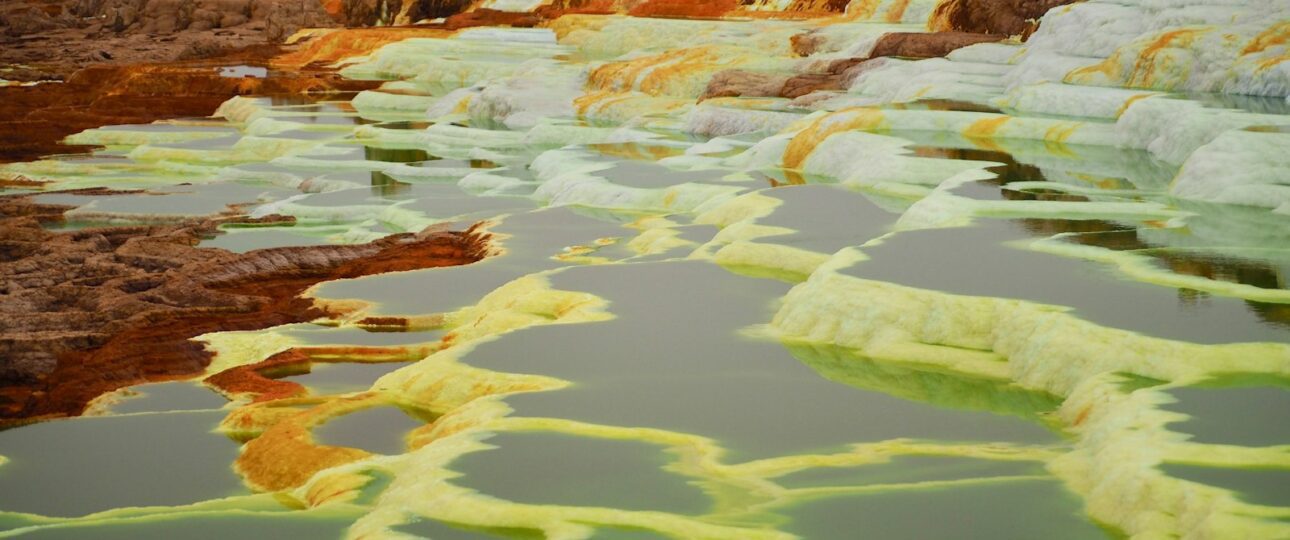
The landscape reads like a fever dream: acid lakes shimmering in impossible neons, sulphur-encrusted vents bubbling in vivid greens and yellows, and at night, the dull red glow of a lava lake visible from the summit crater. Geologists come here to observe processes that shaped early Earth. Travellers come because no photograph fully prepares you for it.
The Danakil Depression is part of the East African Rift System, where the African continent is gradually splitting along three diverging plates. The geological activity is constant: Erta Ale has maintained an active lava lake since at least 1906, Dallol’s hydrothermal fields shift and reform after each rainfall, and the vast salt flats that carpet the basin floor were once the bed of an ancient sea.
Erta Ale: the lava lake that never sleeps
The centrepiece of any Danakil Depression tour is Erta Ale, a shield volcano that has maintained an active lava lake continuously since at least 1906 — one of only a handful of persistent lava lakes on Earth. The name means “smoking mountain” in the Afar language.
You reach the crater rim after a 2–3 hour trek across hardened basalt fields, typically starting after dark to avoid the worst of the heat. The approach is otherworldly: headtorches pick out black lava underfoot while the horizon ahead glows amber. At the summit, you peer into a pit of churning, bubbling magma — the lake heaves and spits, the radiated heat is intense, and sulphur catches in the throat.
Nights on Erta Ale are spent in simple stone shelters near the summit. Bring a warm layer: temperatures drop sharply at altitude. Wake before dawn to watch the lava lake in full colour before the descent.
Dallol: Earth’s most alien landscape
Where Erta Ale offers fire, Dallol offers chemistry. This hydrothermal field on the floor of the basin is the site of a collapsed salt dome, and the brine seeping up through fractures carries iron, sulphur, potassium, and chlorine in concentrations that produce extraordinary mineral formations: caustic acid pools in vivid yellow and green, perfect rings of black brine, and encrusted salt chimneys rising from the flat.
Dallol’s environment is so extreme that until recently scientists believed nothing could survive there. Recent research has now identified microorganisms persisting in this environment — giving astrobiologists clues about life on other planets. A guided tour spends one to two hours at Dallol, usually in the morning before peak heat. Photography is exceptional: the contrast between vivid mineral colours and the white salt plain makes for images that look composited but are entirely real.
The Afar salt caravans
For centuries, the Afar people have harvested salt from the Danakil basin floor, cutting it into uniform blocks and loading it onto camels for the long walk to highland markets. You’ll still see these caravans crossing the flats today: strings of 50–100 camels led by Afar traders, moving at dawn and dusk to avoid the midday heat.
Salt was once used as currency in Ethiopia — a unit called amole — and the caravan tradition has changed little since medieval times. Watching a caravan depart at sunrise, silhouettes moving across a pale salt horizon, is one of those images that remains long after the trip ends.
When to visit and what to expect
The optimal window for a Danakil Depression tour runs from October to February, when temperatures are at their lowest (though still well above 30°C in the basin). March through September brings extreme heat — daytime ground temperatures can exceed 50°C — and access may be restricted by local conditions.
Tours are always conducted in groups with armed Afar escort and experienced local guides. Infrastructure is minimal: accommodation at Erta Ale is basic (sleeping mats in stone shelters near the summit), and at camp in the basin you’ll sleep in tents. Meals are prepared by the tour crew. Water and sun protection are critical — plan for at least 3–4 litres per person per day in the field.
Ready to experience it? Explore our 4-day Danakil Depression Expedition — departures year-round with experienced local guides and full security logistics included.
Frequently Asked Questions
Is the Danakil Depression safe to visit?
With a licensed tour operator and the mandatory armed Afar escort, Danakil tours have a strong safety record. The region requires security clearance and armed escort due to its remote, border-adjacent location. Ethiosinia Tours coordinates all security logistics and has operated in the Danakil for over a decade. Check your government’s current travel advisory before booking.
How fit do you need to be for a Danakil Depression tour?
The Erta Ale trek involves approximately 7–8 km of walking over uneven basalt lava fields, with around 600m of elevation gain. It’s manageable for most travellers with reasonable general fitness. No technical climbing is involved. The greater challenge is heat: pace yourself carefully, drink frequently, and follow your guide’s instructions.
Can I visit the Danakil Depression independently?
No. The Danakil Depression requires a licensed guide, armed escort, and a permit from the Afar Regional Tourism Bureau. Independent travel into the region is not permitted. All access must be through a registered tour operator.
What should I pack for a Danakil tour?
Essentials: sturdy closed-toe shoes or lightweight hiking boots, a wide-brim sun hat and UV-protective clothing, high-SPF sunscreen, a headtorch with spare batteries, a dust mask for the Erta Ale trek, and a warm layer for summit nights (temperatures drop sharply). For photography: bring a dust-proof bag — the salt and sulphur environment is hard on camera equipment.
Planning your dates? The Danakil is at its coolest between November and January — see Ethiopia in December.